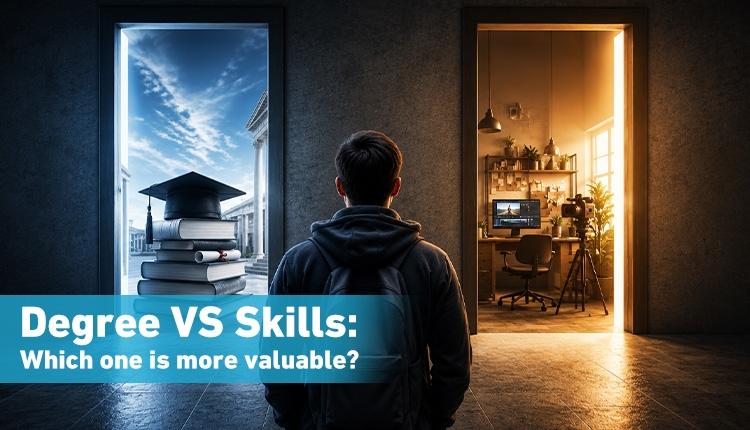
Degree VS Skills: Which one is more valuable in Nepal?
You spent years earning a degree with perfect grades. Then, when you step into an interview room with full confidence, but after reviewing your academic achievement, the interviewer asks a simple question,” What skills do you think make you the right person for this role?” Suddenly, your degree is no longer the center of the conversation. You freeze and ask yourself, “Does this perfect degree mean nothing in front of the skills?”
This scenario is becoming increasingly common in today's job market. While educational qualifications remain important, employers are paying closer attention to what skill does a candidate actually has. They want to know whether applicants can solve problems, communicate effectively, have basic AI skills, and work in teams.
So, does this mean degrees have lost their value? Or have skills become more important than formal education? The answers lie somewhere in between.
The Traditional Importance of Degrees
For generations, a college degree has been viewed as a pathway to a successful future. It was not just a degree; it was viewed as proof of knowledge, dedication, discipline, and commitment.
It's still essential to have a degree for some professions, such as medicine, law, engineering, architecture, and teaching. These jobs involve a formal education, training, and a professional license, so that people are properly trained and licensed to do the job safely and effectively. In other professions, such as graphic design, programming, digital marketing, and content creation, the focus is often less on the degree you hold and more on the skills. Sometimes, a strong portfolio, relevant experience, and skills are more important than a degree. In such sectors, the results you can produce can be more important than your grades.
The relationship between education and employment has always been straightforward: earn a degree, apply for jobs, and build a successful career. While the modern job market has evolved and employers now place greater emphasis on practical skills, the traditional value of a degree continues to hold importance. It remains a strong foundation upon which individuals can build their careers and develop the skills required to succeed in a competitive professional environment. As a result, degrees continue to hold significant value in many industries.
The Rise of Skill-Based Hiring
In today's job market, employers are looking beyond degrees and focusing more on skills. As industries and technology evolve, many companies want candidates who can adapt, have problem-solving skills, and perform job-related tasks effectively.
This shift has led to the rise of skills-based hiring, where employers evaluate candidates based on their abilities, experience, and competencies rather than educational qualifications and degree alone. Many organizations have also found that limiting recruitment to degree holders can exclude highly skilled individuals who are capable of performing the job successfully. As a result, developing relevant skills has become very important for job seekers who want to stand out in a competitive job market.
However, skills-based hiring does not mean degrees have become irrelevant. Instead, it reflects a broader recognition that qualifications alone do not always predict job performance. Employers increasingly seek candidates who can demonstrate both knowledge and practical application.
Industries Where Skills Matter More Than Degrees
Even though degrees remain important in many fields, several industries often focus on what candidates can do rather than the degree or qualifications they hold.
Information Technology
Many employers hire software developers, programmers, cybersecurity specialists, and data analysts based on their technical skills, certifications, and project portfolios. The technical skills they have matter more than the degree they hold.
Digital Marketing
In digital marketing, knowledge of SEO, social media marketing, content writing, paid advertising, graphic design, creative fields, and analytics can be more important than a specific degree.
Sales and Customer Service
Communication, negotiation, and relationship-building skills are often stronger indicators of success in sales and customer service than an academic degree.
Skilled Trades
Professions such as electricians, plumbers, mechanics, and technicians require practical expertise and certifications, often making hands-on skills more valuable than traditional degrees.
In these industries, demonstrating relevant skills and experience can significantly improve a candidate's chances of securing a job and advancing their career.
Situations Where Degrees Still Hold Significant Importance
Despite the growing emphasis on skills, degrees continue to play a crucial role in many careers and industries. In certain situations, formal education remains essential for both employment and career advancement.
Regulated Professions
Fields such as medicine, law, nursing, pharmacy, and engineering require accredited education and licensing to ensure public safety and professional standards. In these fields, a degree is not optional but a mandatory requirement.
Corporate Recruitment Processes
Many large organizations continue to use educational qualifications as a minimum eligibility criterion for certain positions. So in this case, both degree and skill remain essential.
International Opportunities
In some countries and industries, academic qualifications remain an important requirement for work permits, visas, and professional recognition.
Although skills are increasingly valuable, degrees continue to provide knowledge, credibility, and access to opportunities that may not be available through skills alone.
Myth Vs Reality: Degree VS Skills
The debate between degrees and skills has led to several misconceptions about what employers really value. So to clear this confusion, here are a few facts.
Myth 1: A Degree Guarantees a Job
Reality: While a degree can help you qualify for opportunities, it does not guarantee employment. Employers also look for practical skills, experience, and the ability to perform the job.
Myth 2: Skills Are More Important Than Degrees in Every Industry
Reality: Skills are highly valuable, but degrees remain essential in many professions such as medicine, law, engineering, nursing, and teaching. In these fields, formal education is a requirement.
Myth 3: You Can Only Learn Valuable Skills at University
Reality: Learning doesn't stop in the classroom. Many in-demand skills can be developed through internships, online courses, certifications, workshops, volunteer work, and hands-on experience.
Myth 4: Good Grades Are Enough to Impress Employers
Reality: Academic performance matters, but employers also value communication, teamwork, adaptability, leadership, and problem-solving skills. A strong academic record combined with practical skills creates a more competitive profile.
The truth is that neither degrees nor skills alone guarantee career success. In today's job market, the most successful professionals are those who combine formal education with continuous skill development and a willingness to learn.
Conclusion
So, when it comes to career success, which is more valuable: a degree or skills? The answer is neither. In today's job market, both play an important role. A degree provides the knowledge, credibility, and foundation needed for many careers, while skills demonstrate your ability to apply that knowledge in real-world situations.
Rather than viewing skills and degrees as competing factors, it is more useful to see them as complementary. A degree may help you get your foot in the door, but skills help you grow, adapt, and succeed throughout your career.
For Nepali job seekers, the key is to invest in both education and continuous learning. Whether through internships, certifications, online courses, volunteering, or hands-on experience, developing relevant skills alongside formal qualifications can create a strong foundation for long-term career success.
In the end, the most valuable asset is not just a degree or a particular skill set. It is the willingness to keep learning, improving, and adapting to the changing world of work. So it is never “Degree or Skills” but “Degree and Skills”, because both play significant roles in building a successful career. And as Nepal's job market continues to evolve, Merojob remains committed to connecting talented individuals with opportunities that value both.
Recommended Reading: