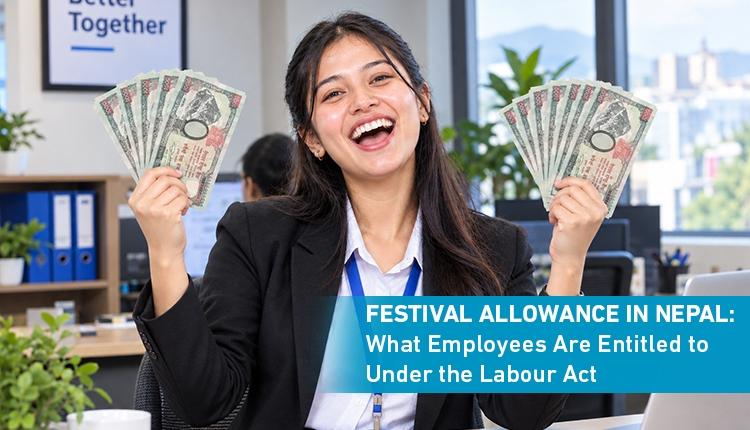
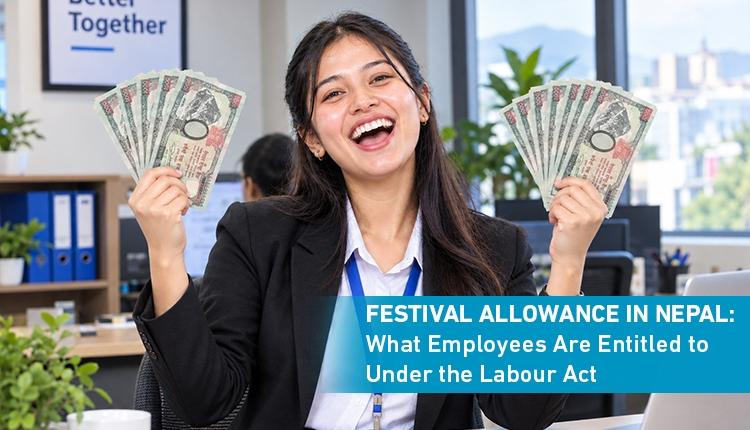
Festival Allowance in Nepal: What Employees Are Entitled to Under the Labour Act
Dashain often comes with extra expenses. Travel, shopping, family gatherings, and other preparations can make the festive season expensive. For many employees, it is also the time when they receive what is commonly called the "Dashain Allowance."
However, many people do not realize that this benefit is not actually a bonus. Under Nepal's Labour Act 2074, employees are entitled to receive a Festival Allowance. It is a legal benefit that employers must provide, not a reward based on performance or company profit.
Understanding how this allowance works can help both employees and employers avoid confusion during the festive season.
Is Dashain Bonus Really a Bonus
In everyday conversations, people often use the term "Dashain Bonus." Legally, it is the festival allowance provided under Section 37 of the Labour Act, 2074.
So, it is not simply an extra payment an employer may choose to provide. It is a mandatory employee benefit under the Labour Act.
Who Is Eligible for Festival Allowance
Employees working in organizations covered under the Labour Act are entitled to receive a festival allowance. The allowance is for all job positions and all departments, regardless of gender, religion, and whether the company is profitable or not.
It does not require a senior staff member to give it to an employee. The benefit is available to all eligible employees, regardless of their level.
Festival Allowance After 1 Year of Service
The law states that every employee is entitled to receive an amount equal to one month’s basic salary as festival allowance every year for the festival they celebrate according to their religion, culture, and tradition. Festival allowance is equal to one month's basic remuneration of the employee for those who have completed one year of working in any organization.
Suppose, for instance, that the basic remuneration of a worker is NPR 12,170, and allowances and other payments are NPR 7,380, which means his/her monthly remuneration is NPR 19,550. The festival allowance as per Section 37 of the Labour Act, 2074, will be calculated on the NPR 12,170 basic salary, not the total monthly remuneration.
Therefore, an employee who has completed one year of service would be entitled to receive NPR 12,170 as festival allowance. The difference is important because employers might use gross monthly income to calculate how much they should be paying their workers.
What If You Have Not Completed One Year at Work
The employees do not need to serve for one full year to receive the award of festival allowance.
In accordance with the provisions of section 37(3) of the Labour Act, the employee will be entitled to receive the festival allowance in proportion to the length of service he or she has completed on the date of payment of the festival allowance.
Suppose an employee has been working for the past 180 days and has a monthly basic salary of NPR 12,170; then he or she would earn the proportionate amount of 1 month's basic salary as festival allowance. This is clarified with the following example.
Festival Allowance = Basic salary /365 × number of days worked
For the example that is provided
Festival allowance = 12,170 /365 * 180
= NPR 6,001.64
This provision will help newly recruited workers also be supported during the festival period.
Does Everyone Have to Receive the Allowance During Dashain
Not necessarily. The Labour Act connects the festival allowance to the employee’s main festival based on their religion, culture, and tradition.
An employee may submit a written request to the employer to get the festival allowance at the time of the main festival that they celebrate. If the employee does not request it, the employer shall issue the allowance during Dashain. Hence, the payment is considered a Dashain Bonus in Nepal.
Is Dashain Bonus the Same as Annual Bonus
No. Many employees and even some employers confuse festival allowance with annual bonus. They are not the same.
The festival allowance comes under Section 37 of the Labour Act, 2074. The profit-based bonus is under the Bonus Act, 2030. The Bonus Act states that 10% of the net profit of a profit-making enterprise shall be paid as a Bonus to the employees, subject to the provisions of this Act.
The two payments are based on different laws and have different rules. Festival allowance does not constitute a bonus of any kind that an employee may be entitled to receive each year.
What Should Employees Check in Their Payslip?
When the festival allowance is credited, employees can check a few basic details:
- Basic salary: Check the basic remuneration used for calculation.
- Service period: Newly hired employees should check whether the allowance has been calculated proportionately.
- Festival allowance: Check the gross amount credited as festival allowance.
- Tax deduction: Check applicable tax deductions.
- Other deductions: Review any other deductions shown on the payslip.
Find Better Career Opportunities with Merojob
A good job is not only about salary. It is also about working for an employer that follows labour laws, values employees, and provides a healthy work environment.
Thousands of opportunities await at Merojob, ranging from entry-level to advanced levels in various industries. Whether you are a beginner looking for your first job or in the middle of your career, seeking a change, or even looking for your next promotion, Merojob can help you connect with employers all over Nepal.
While you're in the process of planning your celebrations for the festival and getting your allowance this Dashain, it could be the perfect opportunity to look into new possibilities and make a move to the next step in your career. Because better opportunities begin with informed career decisions.