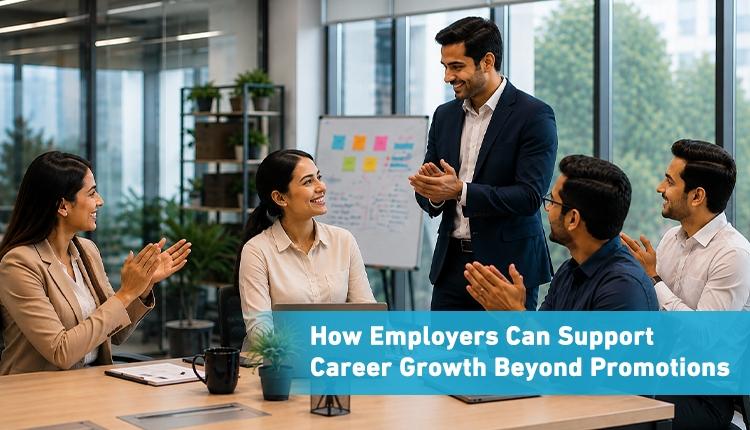
How Employers Can Support Career Growth Beyond Promotions
An employee does good work, learns quickly, and starts taking on more responsibility. After some time, they may naturally start thinking about what comes next. For many employees, the first thought is a promotion.
Promotions can't take place annually for all. It could be only a few senior-level positions, few vacancies available, no immediate vacancy at that time, or there might not be a suitable position at that time. It is a typical scenario for many companies. A company cannot always promote every good employee immediately.
That does not mean the employee’s growth has to stop. Career growth can happen in many ways even without changing the designation. For employers, the question is not always, “Who should we promote?” Sometimes, the better question is, “How can we help our employees grow where they are today?”
Employees can learn new skills, take responsibility for important projects, work with different teams, receive mentorship, or prepare themselves for a future role. As discussed in Merojob's HR Kurakani discussion on employer branding, many professionals today value continuous learning and career growth opportunities as much as promotions. For employers, creating these opportunities can help employees feel that they have a future within the organization.
So, how can employers support career growth even when promotions are not immediately available?
Provide Opportunities for Continuous Learning
One of the simplest ways to support career growth is to give employees opportunities to learn. The skills an employee needs today may not be the same skills they need a few years from now. New technology, changing customer needs, and new ways of working can all change what a job requires.
For example, an accountant may want to improve their Excel and financial reporting skills. A marketing professional may want to learn SEO or data analytics. An HR professional may want to develop skills in HR technology or people analytics.
Employers can support this through:
- Training programs
- Workshops and seminars
- Online courses
- Professional certifications
- Internal learning sessions
- Mentorship and coaching
- Opportunities to learn from experienced colleagues
The goal should not be to send employees to training simply to tick a box. The training should help them do their current job better or prepare them for future responsibilities. When employees feel that their organization is investing in their development, they are more likely to stay motivated and engaged.
Give Employees New Responsibility
Sometimes an employee does not need a new title. They need a new challenge. An employee who has been handling routine tasks for some time may be ready to manage a small project, work directly with a client, train a new team member, or take responsibility for a particular business task. These opportunities allow employees to learn while doing the actual work.
For example, instead of immediately promoting an employee to a team leader, an organization could give them the opportunity to lead a small project. These responsibilities can help employees develop leadership, communication, decision-making, and problem-solving skills. It also gives employers a chance to see how employees perform when given more responsibility.
Encourage Participation in Challenging Projects
Doing the same tasks every day can make employees feel that they are no longer learning. Employees often grow the most when they step outside their comfort zones. Growth often happens when people are given work that makes them think differently.
A challenging project may expose employees to new situations, responsibilities, and learning opportunities. It can help an employee discover what they are good at, where they need improvement, and what kind of work they want to take on in the future. Instead of always giving important projects to the same experienced employees, employers can also give capable team members an opportunity to contribute.
Recognize Growth and Contributions
Recognition is another important part of career development. Employees should not have to wait for an annual performance review to find out how they are doing. Regular feedback gives employees a clearer idea of what they are doing well and what they can improve.
Good feedback does not always have to be formal. A manager can discuss progress after completing a project, recognize good work, or suggest a skill the employee could develop next. When employees feel appreciated, they are more likely to remain committed to their work and continue developing their skills.
Encourage Internal Mobility
Career growth does not always mean moving up. Sometimes, it means moving in a different direction. Employees may want to explore different departments, functions, or responsibilities to expand their knowledge and experience.
For example, an employee in marketing may discover an interest in business development. Someone in customer service may want to move into sales. An HR assistant may want to develop a career in recruitment. Where possible, employers can support internal mobility through cross-functional projects, internal vacancies, job rotations, or opportunities to work with other teams.
This can benefit both sides. Employees get to explore new career paths, while employers can retain people who already understand the organization. This also allows employees to explore new career paths without necessarily leaving the organization.
Build a Culture of Continuous Growth
Supporting career growth should not be treated as a one-time initiative. It should become part of the organization's culture. A workplace where employees can ask questions, learn from mistakes, receive feedback, take on new responsibilities, and discuss their career goals is more likely to make a lot of progress.
A good workplace may not promise every employee a promotion. But it gives employees a reason to believe that they can continue to learn and grow there. Employees are also more likely to stay with organizations that genuinely invest in their future.
Why Career Growth Matters for Employers
Supporting employee growth benefits both employees and employers. Employees gain valuable skills, confidence, and career satisfaction. Employers benefit from a more capable, motivated, and loyal workforce.
In today's competitive job market, career development has become an important factor in attracting and retaining talent. Job seekers increasingly evaluate employers based on the opportunities they provide for learning and professional growth. Employers that provide meaningful opportunities to learn and grow can give their people another reason to stay.
Final Thoughts
Promotions will always be an important part of career progression, but they should not be the only way employees experience growth. Employers can help employees move forward by giving them opportunities to learn, take responsibility, work on challenging projects, receive regular feedback, build relationships, and explore different career paths.
As Nepal's leading recruitment platform, Merojob understands that career development is part of the larger employment journey. By connecting employers and job seekers and providing career and training resources, Merojob supports organizations and professionals as they move toward better opportunities.
A promotion is a valuable milestone, but it should not be the only definition of career growth. Employers may not be able to promote everyone today. But they can give everyone a reason to keep growing.