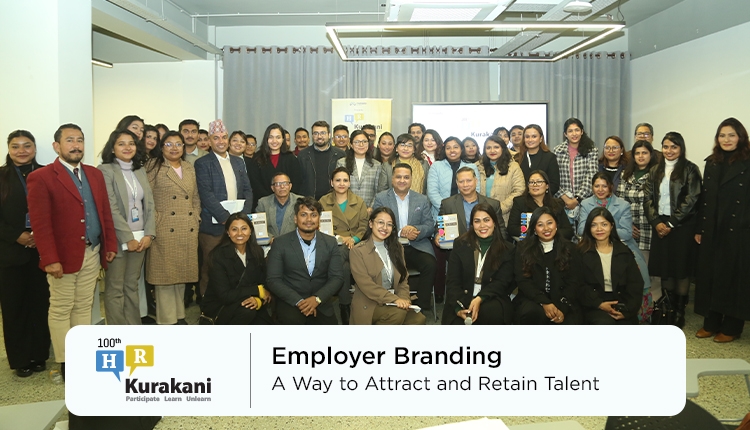
The 100th edition of HR Kurakani was more than a milestone; it was a powerful reflection of how Nepal’s HR landscape has evolved over the years. Held on December 31, 2025, at Embark College, the session brought together HR leaders, founders, recruiters, and managers to engage in an honest, in depth conversation on Employer Branding, A way to attract and retain talent.
Moderated by Shailendra Raj Giri, Founder & Chairman of MeroJob Limited, the discussion captured real workplace challenges and practical insights grounded in lived experiences rather than theory. The conversation focused on what actually matters in today’s job market, why people choose organizations, why they stay, and why they leave.
Employer Branding Starts from Inside the Organization
Opening the session, Shailendra Raj Giri, moderator of HR Kurakani, explained that modern job seekers no longer look at jobs in isolation. Instead, they evaluate organizations through the lens of career development and professional experiences. He emphasized that Employer branding is not about logos or social media posts alone, it is about how employees feel while working in an organization.
He highlighted that candidates today ask deeper questions, What kind of organization is this? What values does it stand for? Will my career grow here? From an employer’s perspective, this shift demands a stronger focus on employer branding, not just product or corporate branding.
“Employer branding is about reputation. It is about creating a place where people want to work and where existing employees want to stay,” he shared.
The 3s of Employer Branding
Employer branding isn't just marketing; it's the entire ecosystem of how your organization attracts, engages, and retains talent.
Shailendra sir explained employer branding through 3s :
- Employee Value Proposition (EVP): The Employer Value Proposition (EVP) defines what your organization genuinely offers its employees and sets you apart in the talent market. It represents the combination of growth, leadership, rewards, purpose, stability, flexibility, learning, and a sense of belonging that employees can expect. A strong EVP is authentic and consistent, reflecting both what the organization promises and what employees actually experience. By clearly communicating this value, the EVP becomes the foundation for attracting, engaging, and retaining the right talent while shaping a positive perception of the employer brand.
- Experience (Employee + Candidate): The Experience layer reflects how the EVP is lived and felt across every stage of the employee and candidate journey. It includes all touchpoints from hiring and onboarding to manager capability, performance management, recognition, internal mobility, wellbeing, and offboarding. Where an organization can create a strong experience-that is, every interaction reinforces the promises made in the EVP-it builds trust and therefore is a highly engaged and loyal organization. Employees who feel that they are supported, recognized, and empowered on their journey, and candidates who have a seamless and welcoming hiring process, will result in a loyal organization. Experience turns the words of the EVP into reality; it creates a tangible view of what it is like to work for the organization.
- Expression (Story + Proof): The Expression layer is how the employer brand is communicated externally and internally, ensuring that the EVP and employee experience are visible, credible, and believable. It is reflected through stories, employee advocacy, leadership communication, community presence, and transparency, always backed by reality. Expression is not just about promotion; it is about demonstrating authenticity. When employees share their experiences, leaders communicate openly, and the organization maintains a visible presence in the community, it reinforces trust in the brand. A strong expression ensures that the promises made through the EVP and lived through experience are consistently understood, recognized, and respected by both current and potential talent.
“Many people today are looking for continuous learning and career progression. Training allowances alone are not enough; the real question is whether employees feel they are growing" he added.
How Candidates Research Employers?
The discussion then moved toward how job seekers research organizations before applying.
Chandrika Acharya, Research Department professional at United Academy Group, shared that candidates primarily explore company websites to understand professionalism, services, and overall credibility.
“The website is usually the first checkpoint. It shows how structured and serious an organization is,” she said.
Adding to this, Alina Manandhara, HR Operations Manager at Technology Developments Pvt Ltd, highlighted the growing role of social media:
“Candidates don’t just look at vacancies. They observe how companies behave on social media, what kind of people join, and how culture is reflected,” she explained.
Manman Group’s Senior HR Officer, Roshika Subedi, also emphasized LinkedIn as a crucial research tool where candidates assess employee count, activities, and professional networks.
The Reality Check: Do Candidates Really Research?
Offering a candid employer side perspective, Urja Karki, representing IGC Business Holding (IT Company), shared a contrasting experience.
“Many applicants apply without knowing anything about the company. During the first level phone interview, some don’t even recognize our organization’s name,” she said.
She explained that mass applications have become easier, but genuine talent still stands out through preparation and research.
“For us, lack of research is a major turn off,” she added.
Meanwhile, Ujjwal Sundas from Samata Foundation stressed the importance of aligning organizational vision and mission with personal goals.
“When candidates see their personal purpose matching the organization’s mission, that’s when long term commitment begins,” he said.
He also emphasized the importance of showcasing Life at Company content through visuals, videos, and employee testimonials.
Social Media: Culture on Display
Aman Lal Shresth, Founder & CEO of Steward Strategies (Management Consulting Firm), highlighted how short form content dominates employer branding today.
“If you don’t exist on Instagram, you don’t exist for the new generation,” he remarked.
He explained that behind the scenes content, real work life moments, and authentic storytelling resonate more than polished festival posts.
At the same time, Anuja Shakya, from Audit Partnership Limited, shared how fresher candidates are particularly influenced by workplace environment and cultural activities.
“Freshers often choose companies based on environment and events, not just salary,” he shared.
Leadership, Transparency, and Trust
A strong message echoed throughout the session, leadership defines employer brand.
Manoj Giri, a legal professional with extensive corporate experience, stressed that transparency, job security, and leadership credibility matter deeply especially in IT and private sector roles.
“People may accept lower pay initially, but they don’t compromise on security and leadership trust,” he said.
Similarly, Bidya Shrestha, Project Professional, highlighted responsible communication and ethical content sharing, especially in development projects.
Jenu Thapa, an HR Professional, spoke at the event about the importance of Employer Branding and Leadership. She shared that learning from books and applying that knowledge in real work situations helps HR and leaders grow.
She strongly emphasized that leadership matters a lot in creating a better place to work. According to her, when line managers work together and clearly understand the organization’s vision, it helps in culture development within the organization.
A Case Study in Purpose Driven Employer Branding
One of the most impactful discussions came from representatives associated with Teach for Nepal style fellowship programs, where recruitment involves parents, alumni, and real field exposure.
The process includes:
- Long, transparent job descriptions
- Clear salary disclosure
- Multi stage assessments
- Parent interaction sessions
- Alumni testimonials and village immersion experiences
“We don’t just recruit candidates, we help families understand the purpose of the work,” shared a participant involved in fellowship recruitment.
This approach, though resource intensive, was highlighted as a powerful employer branding strategy rooted in authentic experience.
The Role of Experience From Hiring to Exit
Employer branding, as discussed, is shaped by experiences at every stage from applying for a job to exiting an organization.
Shailendra Sir highlighted that poor hiring communication, delayed responses, or unprofessional interactions can damage an employer’s brand instantly.
“Candidates apply today and receive a call after 15 days. By then, they have already formed an impression,” he shared.
Shailendra Raj Giri, emphasized that people often leave managers, not organizations. Toxic leadership, lack of communication, and unclear expectations directly affect employee retention.
“Employee experience is not just about perks. It’s about how managers treat people, how feedback is given, and how trust is built,” he noted.
What Makes People Stay?
As the discussion moved to retention, participants agreed on one clear insight, culture matters more than compensation.
Citing internal discussion, Shailendra sir noted:
- Organizational culture
- Growth opportunities
- Salary & benefits
“Salary is important, but it comes third. People stay where they feel respected, valued, and heard,” he emphasized.
Strong leadership, clear growth paths, transparent communication, and work life balance were repeatedly cited as non-negotiables.
As the Discussion Moved to Retention Moderator shared a story.
In Kathmandu, a Traffic Police Officer was assigned to work on the busy streets of Koteshwar. Every day, he faced traffic jams, overflowing garbage, and messy roads. Instead of seeing these as mundane duties, he approached them as opportunities to make a real difference.
He worked tirelessly to manage traffic, clean the streets, and improve the city for everyone. His dedication caught the attention of citizens and her seniors. Naturally, promotions were offered in recognition of his work.
But he politely declined the standard promotion. He said:
“I don’t want to leave the roads. My work is here, where I can make the most impact. If you want to promote me, let it be in a way that allows me to continue serving the streets.”
This story is a powerful reminder that true leadership and fulfillment come from purpose, not position. Real impact is created by individuals who are deeply committed to meaningful work, not merely by those seeking to climb the organizational ladder. At the same time, every individual is motivated differently some find satisfaction and excellence in mastering their roles over time, while others are driven by leadership responsibilities and career progression. Recognizing this diversity is essential. For management and human resources, the real challenge and opportunity lie in understanding, respecting, and supporting these varied aspirations, creating an environment where every employee can contribute, grow, and create lasting change in their own way.
Conclusion
The HR Kurakani 100th Edition successfully captured the realities of today’s job market in Nepal where employer branding is no longer optional, and HR is no longer transactional.
Under the moderation of Shailendra Raj Giri, the session reinforced that employer branding is built every day through leadership decisions, manager behavior, communication style, and employee experience.
As Nepal’s workforce becomes more informed and selective, platforms like HR Kurakani play a critical role in shaping responsible, people-first organizations.
The 100th edition was not just a celebration of conversations past, but a commitment to conversations that will define the future of workplace culture in Nepal.