Nepal Income Tax Slabs for Individual for FY 2083/84: What Has Changed and How Much Can You Save?
The Government of Nepal has introduced significant changes to the individual / personal income tax structure for Fiscal Year 2083/84. Whether you are a salaried employee, individual either single or couple, or pension recipient, or individual with business income, these revised tax slabs could have a noticeable impact on your annual tax liability and take-home income.
The new tax policy provides substantial relief to low and middle-income earners by expanding the lower tax brackets and reducing the highest tax rate from 39% to 29%.
In this guide, we break down the new income tax slabs, compare them with the previous fiscal year, and explain what the changes mean for taxpayers across Nepal.
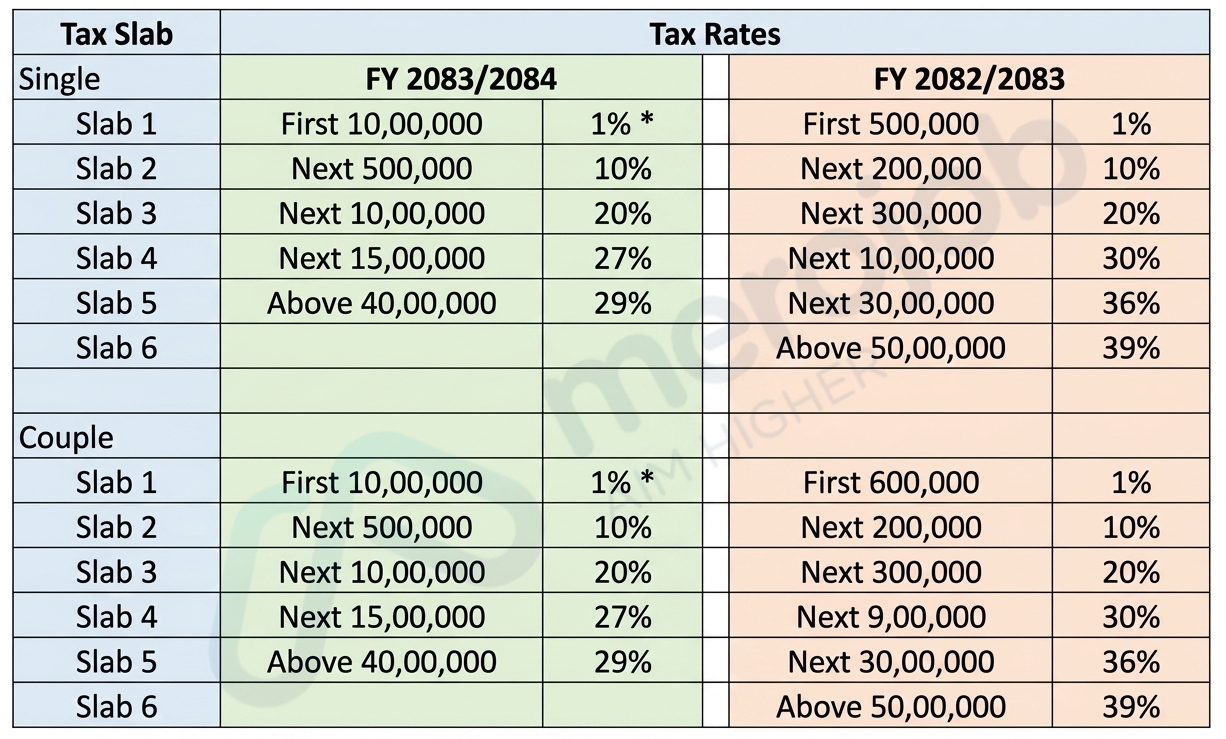
Tax Slabs for FY 2083/84
Key Highlights of Nepal's Income Tax Reform FY 2083/84
1. Larger Tax-Free and Low-Tax Income Threshold
The biggest change is the expansion of the lowest tax bracket.
- Individuals now receive the first Rs. 10,00,000 at just 1% tax
- Married couples also enjoy the same Rs. 10,00,000 thresholds
- Previously, these thresholds were Rs. 5,00,000 for individuals and Rs. 6,00,000 for couples
For many taxpayers, this means significantly lower tax payments compared to FY 2082/83.
2. Maximum Tax Rate Reduced
The highest personal income tax rate has been reduced from 39% to 29%. This makes Nepal's tax structure more competitive and lowers the tax burden on high-income professionals, entrepreneurs, and business owners.
3. Simpler Tax Structure
The previous six-tier system has been streamlined into five tax brackets, making tax calculations easier and more transparent.
Who Is Exempt from the 1% Social Security Tax?
Many taxpayers may not need to pay the 1% tax on the first Rs. 10,00,000 of income.
The 1% Social Security Tax is generally waived for:
- Registered sole proprietorship businesses
- Employees contributing to the Pension / Social Security Fund (SSF)
- Pension income earners
For eligible taxpayers, the effective tax rate on the first Rs. 10,00,000 becomes 0%.
What Do These Changes Mean for Taxpayers?
Salaried Employees
Employees earning up to Rs. 10 lakhs annually will see the biggest benefit, especially if they are enrolled in the Social Security Fund (SSF). Many will pay little or no tax on their first Rs. 10 lakhs of income.
Middle-Income Professionals
The wider 10% and 20% tax brackets reduce the amount of income exposed to higher tax rates, resulting in meaningful annual savings.
High-Income Earners
Professionals, consultants, entrepreneurs, and executives earning above Rs. 40 lakhs annually will benefit from the reduction of the maximum tax rate from 39% to 29%.
Business Owners
Registered sole proprietors may also qualify for exemption from the 1% Social Security Tax, further reducing their overall tax burden.
Example: How Much Better Is the New Tax Structure?
Under the previous tax system, an individual earning Rs. 10 lakhs annually would pass through multiple tax brackets of 1%, 10%, and 20%.Under the new FY 2083/84 structure:
- The entire first Rs. 10 lakhs falls within the lowest bracket
- Eligible SSF contributors may pay 0% tax on this amount
- Most taxpayers will see higher take-home income and lower annual tax obligations
Frequently Asked Questions (FAQs)
Has the highest income tax rate changed?
- Yes. The maximum personal income tax rate has been reduced from 39% to 29%.
Is the first Rs. 10 lakhs completely tax-free?
- Not for everyone. The standard rate is 1%, but eligible SSF contributors, pension fund contributors, pension earners, and certain sole proprietors may qualify for exemption.
Who benefits the most from the new tax slabs?
- Low and middle-income earners receive the greatest relief due to the expanded lower tax brackets. High-income earners also benefit from the reduced top tax rate.
When do the new tax rates apply?
- The revised tax slabs apply for Fiscal Year 2083/84 as announced in Nepal's national budget.
Final Thoughts
The FY 2083/84 income tax reform represents one of Nepal's most significant personal tax revisions in recent years. By expanding the lower tax brackets, simplifying the tax structure, and reducing the maximum tax rate, the government has provided meaningful relief to a wide range of taxpayers.
Whether you are a salaried employee, business owner, pension recipient, or independent professional, understanding these new tax slabs can help you better plan your finances and maximize your after-tax income.